Please resize your window or rotate your device.




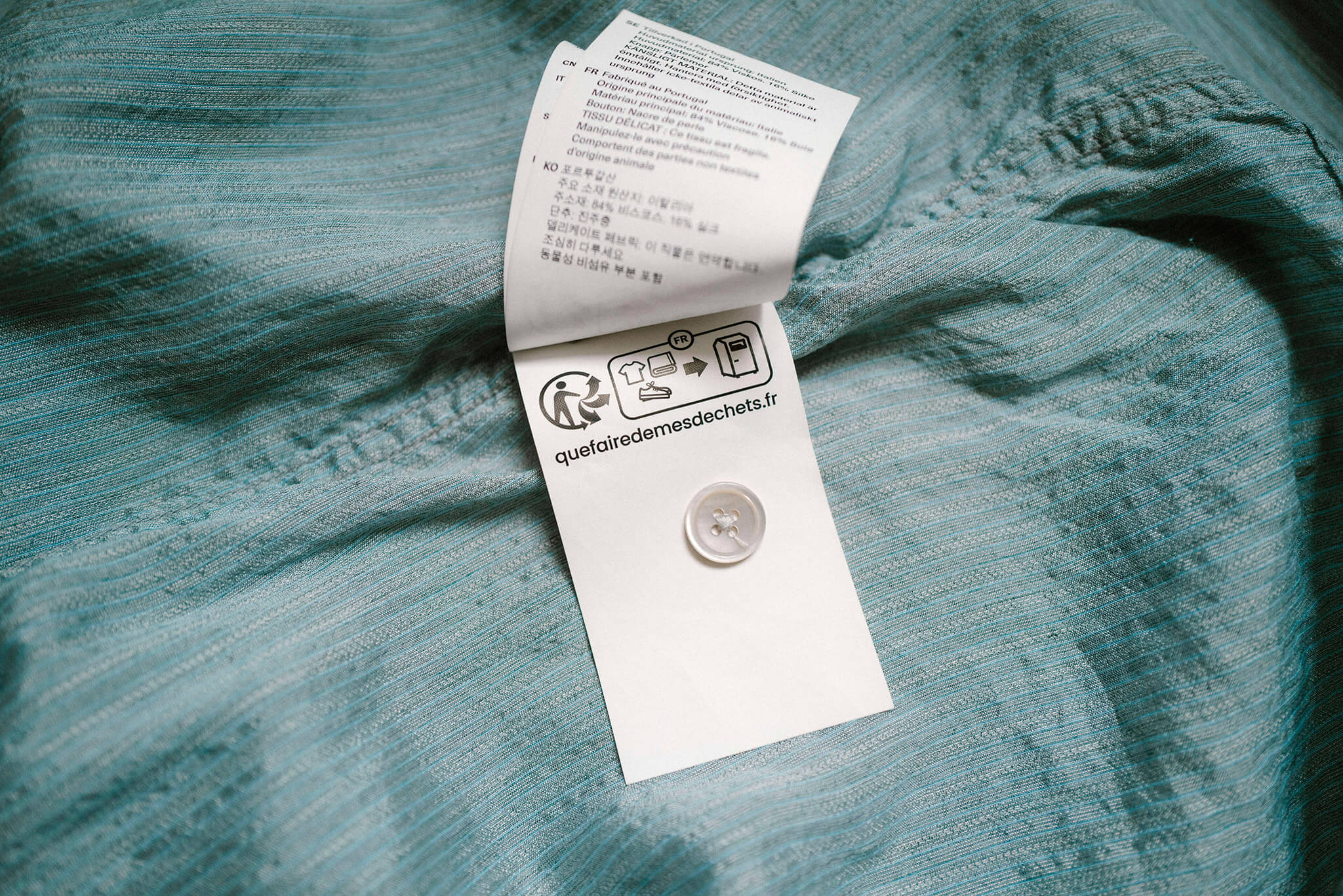
Make sure the labels on your textile products are EU ready with this guide.
You have spent months developing your collection. The fabric is sourced, the samples are approved, and you are ready to start selling in Europe. Then someone asks: is your label compliant for the EU market?
If you cannot answer that question with confidence, you are not alone. The EU Textile Labelling Regulation catches a surprising number of brands off guard, not because it is complicated, but because the details matter in ways that are easy to underestimate.
This article explains what the regulation requires, why it exists, and, most importantly, what you need to do before your first EU order ships.
EU textile labels are not a formality. They are a legal requirement that applies to every product, every market, every order, with no exceptions.
Why does the EU require textile labels?
The EU Textile Labelling Regulation (Regulation (EU) No 1007/2011) was introduced to provide consumers with reliable, standardised information about the materials used in their clothing. It ensures that when a consumer buys a garment labelled “100% Merino Wool” in Sweden or “65% Polyester, 35% Cotton” in Germany, they can trust that the information is accurate, consistently presented, and written in a language they can actually read.
The regulation is not about style or sustainability. It is specifically about fibre composition: what the fabric is made of, in what quantities, and in what order.
Does this apply to your brand?
Yes. If you place textile products on the EU market, this regulation applies to you. There is no minimum size threshold, no revenue exemption, and no grace period for new entrants. The rules apply from day one.
Textile products in scope include virtually all clothing, accessories, and home textiles with a fibre content of at least 80% by weight. This covers:
- All clothing and garments
- Accessories with significant textile content (scarves, hats, gloves, bags)
- Home textiles (bedding, towels, curtains)
A few things are outside the scope of this regulation:
- The textile parts of footwear (shoe uppers)
- Products with less than 80% textile fibres by weight (e.g., some down-filled duvets)
- Business-to-business sales
What exactly must go on the label?
The regulation has one mandatory requirement: the fibre composition of the textile product.
Everything else is either required by other regulations (GPSR traceability), strongly recommended (care instructions, size, country of origin), or optional.
Fibre composition
Every textile product must carry a label stating its full fibre composition using the exact fibre names defined in Annex I of the regulation. The label must:
- List all fibres present in the product
- State the percentage of each fibre, in descending order (highest percentage first)
- Use the EU-approved fibre name, not trade names or marketing terms
- Be accurate to within the manufacturer's tolerance of ±3 percentage points per fibre
The language rule
This is the requirement that catches the most non-EU brands off guard.
The fibre composition label must be written in the official language or languages of the EU member state where the product is sold.
This means English is not acceptable for most EU markets. A label written in English may be fine for Ireland, but it is not compliant for Sweden, Germany, France, Italy, Poland, or most other EU countries.
Fibre composition for complex products
Some products are more complicated than a single fabric, they may have linings, interlinings, separate parts, or decorative components. Here is how the regulation handles the most common situations:
Label presentation and attachment
The regulation requires that labels are:
- Durable: the label must remain legible throughout the product's normal use
- Clearly legible: use a clear font, sufficient contrast, readable text size
- Visible and accessible: consumers must be able to read it before purchase
- Firmly attached: the label should not come off in normal use or washing
The regulation does not specify a minimum font size, a particular style, or a required label format.
What matters is that the fibre composition information is clearly separated from other information on the label (such as care instructions or brand name) and written in uniform lettering throughout.
What the regulation does NOT require, but you should include anyway
The Textile Labelling Regulation is specifically about fibre composition. It does not legally require you to include care instructions, size labelling, or country of origin. But here is the reality:
The five most common labelling mistakes and how to avoid them
1. Using English fibre names for non-English EU markets
Writing “100% Cotton” on a product sold in Sweden is not compliant. The label must say “100% Bomull.” This is the single most common labelling error we see from non-EU brands entering the market for the first time.
Fix: Create market-specific labels, or design a multi-language label that covers all your target markets from the start.
2. Using trade names instead of EU fibre names
“Tencel”, “Nylon” “Lycra”, “Spandex”, “Rayon”: these are brand names, not EU-approved fibre names. Your label must use the official names from Annex I of the regulation.
Fix: Before printing labels, cross-check every fibre name against the approved list. Your label printer or compliance consultant can verify this.
3. Inaccurate percentages
The regulation allows a manufacturer’s tolerance of ±3 percentage points per fibre. But if your label says 80% Cotton / 20% Polyester and the actual composition is 70% Cotton / 30% Polyester, that is a violation.
Fix: Obtain fibre composition certificates from your fabric supplier and ensure your labels reflect the certified composition, not an approximation.
4. Missing the “non-textile parts of animal origin” statement
A garment with leather trim, down filling, or bone buttons must include the specific statement about non-textile parts of animal origin. This is often omitted because brands do not realise it applies to small components.
Fix: Review every product for animal-origin components, no matter how minor, and add the statement where required.
5. Labels that fall off or become illegible
A label that peels off after one wash is not compliant. The regulation requires labels to be durable and to remain legible throughout normal use.
Fix: Wash-test your care labels before committing to a large production run. Woven labels are generally more durable than printed ones for care and composition information.
Frequently asked questions
Key resources
To go deeper, the following sources are authoritative and publicly accessible:
- Bergstrand’s free EU Compliance Guide
- Regulation (EU) No 1007/2011: the Textile Labelling Regulation in full
- European Commission textile sector guidance
- Approved EU fibre names: Annex I of Regulation (EU) No 1007/2011
- ISO 3758:2023 care labelling symbols
- Swedish Consumer Agency (Konsumentverke) guidance for the Swedish market
Simplify your EU market entry.
Between Textile Labelling, GPSR, and upcoming EPR rules, entering the EU market requires careful planning. Let Bergstrand’s experts build a tailored EU Market Entry Compliance Strategy for your brand, so you can focus on design and sales, not legal footnotes.

As trusted by






Build a sustainability strategy that works
You need practical solutions for compliance, traceability, and materials from experts that specialise in fashion and textiles.
Tell us where your brand stands today and we will map out the next steps.
Thank you for your enquiry.
A member of our team will get back to you within 24 hours.
If you’re curious to see how we’ve helped our other clients, feel free to browse our Case Studies.



Stay ahead of the latest sustainability and compliance developments
Requirements for brands are constantly changing.
Subscribers to our newsletter receive a monthly update on the latest topics that concern fashion, textile and apparel brands.
Subscribe now to stay on top.